radix = args.at(1);
// Convert {string} to a String first, and flatten it.
Handle subject;
ASSIGN_RETURN_FAILURE_ON_EXCEPTION(isolate, subject,
Object::ToString(isolate, string));
subject = String::Flatten(isolate, subject);
// Convert {radix} to Int32.
if (!radix->IsNumber()) {
ASSIGN_RETURN_FAILURE_ON_EXCEPTION(isolate, radix,
Object::ToNumber(isolate, radix));
}
int radix32 = DoubleToInt32(radix->Number());
if (radix32 != 0 && (radix32 < 2 || radix32 > 36)) {
return ReadOnlyRoots(isolate).nan_value();
}
double result = StringToInt(isolate, subject, radix32);
return *isolate->factory()->NewNumber(result);
}
`
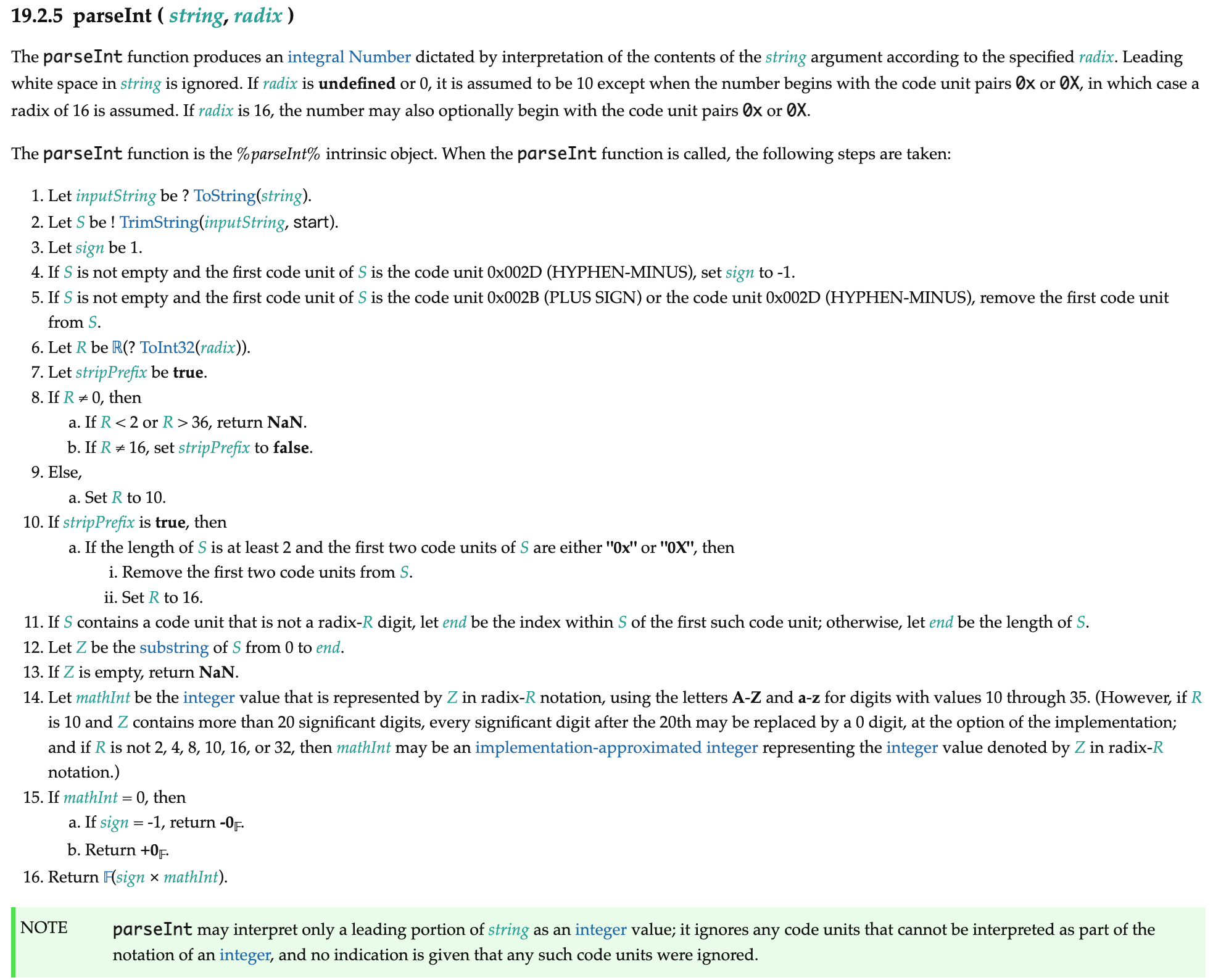
这段逻辑比较简单,就不再一行行解读了。值得注意的是,根据标准,如果 radix 不在 2~36 的范围内,会返回 NaN。
1.2 JavaScriptCore 中的 parseInt()
接着我们来看看 JavaScriptCore 中的 parseInt()。
JavaScriptCore 中关于 JS 语言内置对象的注册都在 [→ runtime/JSGlobalObjectFuntions.cpp] 文件中:
`JSC_DEFINE_HOST_FUNCTION(globalFuncParseInt, (JSGlobalObject* globalObject, CallFrame* callFrame))
{
JSValue value = callFrame->argument(0);
JSValue radixValue = callFrame->argument(1);
// Optimized handling for numbers:
// If the argument is 0 or a number in range 10^-6 <= n < INT_MAX+1, then parseInt
// results in a truncation to integer. In the case of -0, this is converted to 0.
//
// This is also a truncation for values in the range INT_MAX+1 <= n < 10^21,
// however these values cannot be trivially truncated to int since 10^21 exceeds
// even the int64_t range. Negative numbers are a little trickier, the case for
// values in the range -10^21 < n <= -1 are similar to those for integer, but
// values in the range -1 < n <= -10^-6 need to truncate to -0, not 0.
static const double tenToTheMinus6 = 0.000001;
static const double intMaxPlusOne = 2147483648.0;
if (value.isNumber()) {
    double n = value.asNumber();
    if (((n < intMaxPlusOne && n >= tenToTheMinus6) || !n) && radixValue.isUndefinedOrNull())
        return JSValue::encode(jsNumber(static_cast<int32_t>(n)));
}

// If ToString throws, we shouldn't call ToInt32.
return toStringView(globalObject, value, [&] (StringView view) {
    return JSValue::encode(jsNumber(parseInt(view, radixValue.toInt32(globalObject))));
});
}
`
WebKit 中的代码注释都很详尽易读,这里也不再解读了。最后,会调用 parseInt,JavaScriptCore 的 parseInt 的实现全放在了 [→ runtime/ParseInt.h] 中,核心代码如下:
`ALWAYS_INLINE static bool isStrWhiteSpace(UChar c)
{
// https://tc39.github.io/ecma262/#sec-tonumber-applied-to-the-string-type
return Lexer::isWhiteSpace(c) || Lexer::isLineTerminator(c);
}
// ES5.1 15.1.2.2
template
ALWAYS_INLINE
static double parseInt(StringView s, const CharType* data, int radix)
{
// 1. Let inputString be ToString(string).
// 2. Let S be a newly created substring of inputString consisting of the first character that is not a
// StrWhiteSpaceChar and all characters following that character. (In other words, remove leading white
// space.) If inputString does not contain any such characters, let S be the empty string.
int length = s.length();
int p = 0;
while (p < length && isStrWhiteSpace(data[p]))
++p;
// 3. Let sign be 1.
// 4. If S is not empty and the first character of S is a minus sign -, let sign be -1.
// 5. If S is not empty and the first character of S is a plus sign + or a minus sign -, then remove the first character from S.
double sign = 1;
if (p < length) {
    if (data[p] == '+')
        ++p;
    else if (data[p] == '-') {
        sign = -1;
        ++p;
    }
}

// 6. Let R = ToInt32(radix).
// 7. Let stripPrefix be true.
// 8. If R != 0,then
//   b. If R != 16, let stripPrefix be false.
// 9. Else, R == 0
//   a. LetR = 10.
// 10. If stripPrefix is true, then
//   a. If the length of S is at least 2 and the first two characters of S are either ―0x or ―0X,
//      then remove the first two characters from S and let R = 16.
// 11. If S contains any character that is not a radix-R digit, then let Z be the substring of S
//     consisting of all characters before the first such character; otherwise, let Z be S.
if ((radix == 0 || radix == 16) && length - p >= 2 && data[p] == '0' && (data[p + 1] == 'x' || data[p + 1] == 'X')) {
    radix = 16;
    p += 2;
} else if (radix == 0)
    radix = 10;

// 8.a If R < 2 or R > 36, then return NaN.
if (radix < 2 || radix > 36)
    return PNaN;

// 13. Let mathInt be the mathematical integer value that is represented by Z in radix-R notation, using the letters
//     A-Z and a-z for digits with values 10 through 35. (However, if R is 10 and Z contains more than 20 significant
//     digits, every significant digit after the 20th may be replaced by a 0 digit, at the option of the implementation;
//     and if R is not 2, 4, 8, 10, 16, or 32, then mathInt may be an implementation-dependent approximation to the
//     mathematical integer value that is represented by Z in radix-R notation.)
// 14. Let number be the Number value for mathInt.
int firstDigitPosition = p;
bool sawDigit = false;
double number = 0;
while (p < length) {
    int digit = parseDigit(data[p], radix);
    if (digit == -1)
        break;
    sawDigit = true;
    number *= radix;
    number += digit;
    ++p;
}

// 12. If Z is empty, return NaN.
if (!sawDigit)
    return PNaN;

// Alternate code path for certain large numbers.
if (number >= mantissaOverflowLowerBound) {
    if (radix == 10) {
        size_t parsedLength;
        number = parseDouble(s.substring(firstDigitPosition, p - firstDigitPosition), parsedLength);
    } else if (radix == 2 || radix == 4 || radix == 8 || radix == 16 || radix == 32)
        number = parseIntOverflow(s.substring(firstDigitPosition, p - firstDigitPosition), radix);
}

// 15. Return sign x number.
return sign * number;
}
ALWAYS_INLINE static double parseInt(StringView s, int radix)
{
if (s.is8Bit())
return parseInt(s, s.characters8(), radix);
return parseInt(s, s.characters16(), radix);
}
template
static ALWAYS_INLINE typename std::invoke_result<CallbackWhenNoException, StringView>::type toStringView(JSGlobalObject* globalObject, JSValue value, CallbackWhenNoException callback)
{
VM& vm = getVM(globalObject);
auto scope = DECLARE_THROW_SCOPE(vm);
JSString* string = value.toStringOrNull(globalObject);
EXCEPTION_ASSERT(!!scope.exception() == !string);
if (UNLIKELY(!string))
return { };
auto viewWithString = string->viewWithUnderlyingString(globalObject);
RETURN_IF_EXCEPTION(scope, { });
RELEASE_AND_RETURN(scope, callback(viewWithString.view));
}
// Mapping from integers 0..35 to digit identifying this value, for radix 2..36.
const char radixDigits[] = “0123456789abcdefghijklmnopqrstuvwxyz”;
`
直接贴出了代码,因为 JavaScriptCore 中的 API 都是严格按照 ECMAScript (ECMA-262) parseInt 标准一步一步按流程实现,可读性和注释也很好,强烈建议读者自己阅读一下,此处不再解读。
1.3 QuickJS 中的 parseInt()
QuickJS 的核心代码都在 [→ quickjs.c] 中,首先是 parseInt 的注册代码:
/* global object */ static const JSCFunctionListEntry js_global_funcs[] = { JS_CFUNC_DEF("parseInt", 2, js_parseInt ), //... }
js_parseInt 的实现逻辑如下:
`static JSValue js_parseInt(JSContext *ctx, JSValueConst this_val,
int argc, JSValueConst *argv)
{
const char *str, *p;
int radix, flags;
JSValue ret;
str = JS_ToCString(ctx, argv[0]);
if (!str)
    return JS_EXCEPTION;
if (JS_ToInt32(ctx, &radix, argv[1])) {
    JS_FreeCString(ctx, str);
    return JS_EXCEPTION;
}
if (radix != 0 && (radix < 2 || radix > 36)) {
    ret = JS_NAN;
} else {
    p = str;
    p += skip_spaces(p);
    flags = ATOD_INT_ONLY | ATOD_ACCEPT_PREFIX_AFTER_SIGN;
    ret = js_atof(ctx, p, NULL, radix, flags);
}
JS_FreeCString(ctx, str);
return ret;
}
`
Bellard 大神的代码注释很少,但同时也非常精炼。
至此,本文介绍完了三个引擎下各自 parseInt 的实现,三者都是基于标准的实现,但由于代码风格不同,读起来也像是阅读三个风格不同散文大家的作品。
不过标准和实现,我们可以发现 parseInt 在真正执行字符串转数字这个操作做了非常多的前置操作,如入参合法判断、入参默认值、字符串格式判断与规整化、越界判断等等,最后再交由 runtime 处理。因此,我们不难推出其效率略低的原因。
接下来,我们再简单看看 parseFloat。
2. parseFloat()
ECMAScript (ECMA-262) parseFloat
根据标准,parseFloat 与 parseInt 有两点明显的不同:
2.1 V8 中的 parseFloat()
V8 中 parseFloat 的相关逻辑都紧挨着 parseInt,这里直接贴出关键实现:
[→ src/builtins/number.tq]
// ES6 #sec-number.parsefloat transitioning javascript builtin NumberParseFloat( js-implicit context: NativeContext)(value: JSAny): Number { try { typeswitch (value) { case (s: Smi): { return s; } case (h: HeapNumber): { // The input is already a Number. Take care of -0. // The sense of comparison is important for the NaN case. return (Convert<float64>(h) == 0) ? SmiConstant(0) : h; } case (s: String): { goto String(s); } case (HeapObject): { goto String(string::ToString(context, value)); } } } label String(s: String) { // Check if the string is a cached array index. const hash: NameHash = s.raw_hash_field; if (IsIntegerIndex(hash) && hash.array_index_length < kMaxCachedArrayIndexLength) { const arrayIndex: uint32 = hash.array_index_value; return SmiFromUint32(arrayIndex); } // Fall back to the runtime to convert string to a number. return runtime::StringParseFloat(s); } }
[→ src/runtime/runtime-numbers.cc]
`// ES6 18.2.4 parseFloat(string)
RUNTIME_FUNCTION(Runtime_StringParseFloat) {
HandleScope shs(isolate);
DCHECK_EQ(1, args.length());
Handle subject = args.at(0);
double value = StringToDouble(isolate, subject, ALLOW_TRAILING_JUNK,
std::numeric_limits::quiet_NaN());
return *isolate->factory()->NewNumber(value);
}
`
因标准中的流程更为简易,因此较 parseInt 而言, parseFloat 更加简单易读。
2.2 JavaScriptCore 中的 parseFloat()
在 JavaScriptCore 中,parseFloat 的逻辑则更加简洁明了:
`static double parseFloat(StringView s)
{
unsigned size = s.length();
if (size == 1) {
    UChar c = s[0];
    if (isASCIIDigit(c))
        return c - '0';
    return PNaN;
}

if (s.is8Bit()) {
    const LChar* data = s.characters8();
    const LChar* end = data + size;

    // Skip leading white space.
    for (; data < end; ++data) {
        if (!isStrWhiteSpace(*data))
            break;
    }

    // Empty string.
    if (data == end)
        return PNaN;

    return jsStrDecimalLiteral(data, end);
}

const UChar* data = s.characters16();
const UChar* end = data + size;

// Skip leading white space.
for (; data < end; ++data) {
    if (!isStrWhiteSpace(*data))
        break;
}

// Empty string.
if (data == end)
    return PNaN;

return jsStrDecimalLiteral(data, end);
}
`
2.3 QuickJS 中的 parseFloat()
而对比 JavaScriptCore,QuickJS 则短短 12 行:
[→ quickjs.c]
`static JSValue js_parseFloat(JSContext *ctx, JSValueConst this_val,
int argc, JSValueConst *argv)
{
const char *str, *p;
JSValue ret;
str = JS_ToCString(ctx, argv[0]);
if (!str)
    return JS_EXCEPTION;
p = str;
p += skip_spaces(p);
ret = js_atof(ctx, p, NULL, 10, 0);
JS_FreeCString(ctx, str);
return ret;
}
`
不过对比之后可以知道,QuickJS 这里之所以短小,是没有做 ASCII 和 8Bit 的兼容。阅读 ECMAScript (ECMA-262) parseFloat 之后可以发现,QuickJS 这里的处理其实没有什么问题,最新的标准中并没有要求解释器要这样的兼容。
3. Number()
ECMAScript (ECMA-262) Number ( value )
3.1 V8 中的 Number()
Number 作为全局对象,定义还是在 [→ src/init/bootstrapper.cc] 中,在前文介绍 Number.parseInt 的注册时已然介绍过,我们回顾下:
`Handle number_fun = InstallFunction(
isolate_, global, “Number”, JS_PRIMITIVE_WRAPPER_TYPE,
JSPrimitiveWrapper::kHeaderSize, 0,
isolate_->initial_object_prototype(), Builtin::kNumberConstructor);
number_fun->shared().DontAdaptArguments();
number_fun->shared().set_length(1);
InstallWithIntrinsicDefaultProto(isolate_, number_fun,
Context::NUMBER_FUNCTION_INDEX);
// Create the %NumberPrototype%
Handle prototype = Handle::cast(
factory->NewJSObject(number_fun, AllocationType::kOld));
prototype->set_value(Smi::zero());
JSFunction::SetPrototype(number_fun, prototype);
// Install the “constructor” property on the {prototype}.
JSObject::AddProperty(isolate_, prototype, factory->constructor_string(),
number_fun, DONT_ENUM);
`
这段代码处理注册了 Number 这个对象之外,还初始化了它的原型链,并把构造函数添加到了它的原型链上。构造函数 Builtin::kNumberConstructor 是 Torque 实现的 Builtin,[→ src/builtins/constructor.tq] ,具体实现如下:
`// ES #sec-number-constructor
transitioning javascript builtin
NumberConstructor(
js-implicit context: NativeContext, receiver: JSAny, newTarget: JSAny,
target: JSFunction)(…arguments): JSAny {
// 1. If no arguments were passed to this function invocation, let n be +0.
let n: Number = 0;
if (arguments.length > 0) {
// 2. Else,
// a. Let prim be ? ToNumeric(value).
// b. If Type(prim) is BigInt, let n be the Number value for prim.
// c. Otherwise, let n be prim.
const value = arguments[0];
n = ToNumber(value, BigIntHandling::kConvertToNumber);
}
// 3. If NewTarget is undefined, return n.
if (newTarget == Undefined) return n;
// 4. Let O be ? OrdinaryCreateFromConstructor(NewTarget,
// “%NumberPrototype%”, « [[NumberData]] »).
// 5. Set O.[[NumberData]] to n.
// 6. Return O.
// We ignore the normal target parameter and load the value from the
// current frame here in order to reduce register pressure on the fast path.
const target: JSFunction = LoadTargetFromFrame();
const result = UnsafeCast(
FastNewObject(context, target, UnsafeCast(newTarget)));
result.value = n;
return result;
}
`
注释中的 1-6 一一对应着[ECMAScript (ECMA-262) Number ( value )]标准中的流程 1-6,因此本文不再花篇章赘述其实现。需要注意的是,标准中明确说明了 Number 是支持 BigInt 的,各引擎的实现也着重注意了这点,这也证明了我们之前运算对照表中的结果。
3.2 JavaScriptCore 中的 Number()
JavaScriptCore 中的这段代码则缺少注释,但逻辑上与 V8 一模一样,遵循标准:
[→ runtime/NumberConstructor.cpp]
`// ECMA 15.7.1
JSC_DEFINE_HOST_FUNCTION(constructNumberConstructor, (JSGlobalObject* globalObject, CallFrame* callFrame))
{
VM& vm = globalObject->vm();
auto scope = DECLARE_THROW_SCOPE(vm);
double n = 0;
if (callFrame->argumentCount()) {
JSValue numeric = callFrame->uncheckedArgument(0).toNumeric(globalObject);
RETURN_IF_EXCEPTION(scope, { });
if (numeric.isNumber())
n = numeric.asNumber();
else {
ASSERT(numeric.isBigInt());
numeric = JSBigInt::toNumber(numeric);
ASSERT(numeric.isNumber());
n = numeric.asNumber();
}
}
JSObject* newTarget = asObject(callFrame->newTarget());
Structure* structure = JSC_GET_DERIVED_STRUCTURE(vm, numberObjectStructure, newTarget, callFrame->jsCallee());
RETURN_IF_EXCEPTION(scope, { });

NumberObject* object = NumberObject::create(vm, structure);
object->setInternalValue(vm, jsNumber(n));
return JSValue::encode(object);
}
`
3.3 QuickJS 中的 Number()
Number 对象及其原型链的注册代码如下所示:
[→ quickjs.c]
`void JS_AddIntrinsicBaseObjects(JSContext *ctx)
{
//…
/* Number */
ctx->class_proto[JS_CLASS_NUMBER] = JS_NewObjectProtoClass(ctx, ctx->class_proto[JS_CLASS_OBJECT], JS_CLASS_NUMBER);
JS_SetObjectData(ctx, ctx->class_proto[JS_CLASS_NUMBER], JS_NewInt32(ctx, 0));
JS_SetPropertyFunctionList(ctx, ctx->class_proto[JS_CLASS_NUMBER], js_number_proto_funcs, countof(js_number_proto_funcs));

number_obj = JS_NewGlobalCConstructor(ctx, "Number", js_number_constructor, 1, ctx->class_proto[JS_CLASS_NUMBER]);

JS_SetPropertyFunctionList(ctx, number_obj, js_number_funcs, countof(js_number_funcs));
}
`
同样的时候,在原型链注册的时候绑上了构造函数 js_number_constructor :
static JSValue js_number_constructor(JSContext *ctx, JSValueConst new_target, int argc, JSValueConst *argv) { JSValue val, obj; if (argc == 0) { val = JS_NewInt32(ctx, 0); } else { val = JS_ToNumeric(ctx, argv[0]); if (JS_IsException(val)) return val; switch(JS_VALUE_GET_TAG(val)) { #ifdef CONFIG_BIGNUM case JS_TAG_BIG_INT: case JS_TAG_BIG_FLOAT: { JSBigFloat *p = JS_VALUE_GET_PTR(val); double d; bf_get_float64(&p->num, &d, BF_RNDN); JS_FreeValue(ctx, val); val = __JS_NewFloat64(ctx, d); } break; case JS_TAG_BIG_DECIMAL: val = JS_ToStringFree(ctx, val); if (JS_IsException(val)) return val; val = JS_ToNumberFree(ctx, val); if (JS_IsException(val)) return val; break; #endif default: break; } } if (!JS_IsUndefined(new_target)) { obj = js_create_from_ctor(ctx, new_target, JS_CLASS_NUMBER); if (!JS_IsException(obj)) JS_SetObjectData(ctx, obj, val); return obj; } else { return val; } }
值得关注的是 QuickJS 追求精简小巧,因此可以自行配置是否支持 BigInt,其余逻辑依然遵循标准。
4. Double tilde (~~) Operator
ECMAScript (ECMA-262) Bitwise NOT Operator
4.1 V8 中的 BitwiseNot
首先看看 V8 中对一元运算符的判断:
[→ src/parsing/token.h]
static bool IsUnaryOp(Value op) { return base::IsInRange(op, ADD, VOID); }
定义在 ADD 和 VOID 范围内的 op,都是一元运算符,具体包括 (可见 [→ src/parsing/token.h]),其中 SUB 和 ADD 定义在二元运算符列表的末端,在 IsUnaryOp 中它们也会命中一元符的判断:
E(T, ADD, "+", 12) E(T, SUB, "-", 12) T(NOT, "!", 0) T(BIT_NOT, "~", 0) K(DELETE, "delete", 0) K(TYPEOF, "typeof", 0) K(VOID, "void", 0)
之后进入语法分析阶段,解析 AST 树的过程中,遇到一元运算符会做相应的处理,先调用 ParseUnaryOrPrefixExpression 之后构建一元运算符表达式 BuildUnaryExpression:
[→ src/parsing/parser-base.h]
`template
typename ParserBase::ExpressionT
ParserBase::ParseUnaryExpression() {
// UnaryExpression ::
// PostfixExpression
// ‘delete’ UnaryExpression
// ‘void’ UnaryExpression
// ‘typeof’ UnaryExpression
// ’++’ UnaryExpression
// ’—’ UnaryExpression
// ’+’ UnaryExpression
// ’-’ UnaryExpression
// ’~’ UnaryExpression
// ’!’ UnaryExpression
// [+Await] AwaitExpression[?Yield]
Token::Value op = peek();
// 一元运算符处理
if (Token::IsUnaryOrCountOp(op)) return ParseUnaryOrPrefixExpression();
if (is_await_allowed() && op == Token::AWAIT) {
// await 处理
return ParseAwaitExpression();
}
return ParsePostfixExpression();
}
`
`template
typename ParserBase::ExpressionT
ParserBase::ParseUnaryOrPrefixExpression() {
//…
//…
// Allow the parser’s implementation to rewrite the expression.
return impl()->BuildUnaryExpression(expression, op, pos);
}
`
[→ src/parsing/parser.cc]
Expression* Parser::BuildUnaryExpression(Expression* expression, Token::Value op, int pos) { DCHECK_NOT_NULL(expression); const Literal* literal = expression->AsLiteral(); if (literal != nullptr) { // ! if (op == Token::NOT) { // Convert the literal to a boolean condition and negate it. return factory()->NewBooleanLiteral(literal->ToBooleanIsFalse(), pos); } else if (literal->IsNumberLiteral()) { // Compute some expressions involving only number literals. double value = literal->AsNumber(); switch (op) { // + case Token::ADD: return expression; // - case Token::SUB: return factory()->NewNumberLiteral(-value, pos); // ~ case Token::BIT_NOT: return factory()->NewNumberLiteral(~DoubleToInt32(value), pos); default: break; } } } return factory()->NewUnaryOperation(op, expression, pos); }
如果字面量是数值型且一元运算符此刻不是 NOT(!),那么会把 Value 会转成 Number,如果是 BIT_NOT 再转成 INT32 进行取反运算。
4.2 JavaScriptCore 中的 BitwiseNot
同样在语法分析生成 AST 阶段,处理到 TILDE(~) 这个 token 后,创建表达式时会做类型转换的工作:
[→ Parser/Parser.cpp]
template <typename LexerType> template <class TreeBuilder> TreeExpression Parser<LexerType>::parseUnaryExpression(TreeBuilder& context) { //... 省略无关代码 while (tokenStackDepth) { switch (tokenType) { //... 省略无关代码 // ~ case TILDE: expr = context.makeBitwiseNotNode(location, expr); break; // + case PLUS: expr = context.createUnaryPlus(location, expr); break; //... 省略无关代码 } } }
[→ parser/ASTBuilder.h]
ExpressionNode* ASTBuilder::makeBitwiseNotNode(const JSTokenLocation& location, ExpressionNode* expr) { if (expr->isNumber()) return createIntegerLikeNumber(location, ~toInt32(static_cast<NumberNode*>(expr)->value())); return new (m_parserArena) BitwiseNotNode(location, expr); }
[→ parser/NodeConstructors.h]
inline BitwiseNotNode::BitwiseNotNode(const JSTokenLocation& location, ExpressionNode* expr) : UnaryOpNode(location, ResultType::forBitOp(), expr, op_bitnot) { }
[→ parser/ResultType.h]
`static constexpr ResultType forBitOp()
{
return bigIntOrInt32Type();
}
static constexpr ResultType bigIntOrInt32Type()
{
return ResultType(TypeMaybeBigInt | TypeInt32 | TypeMaybeNumber);
}
`
4.3 QuickJS 中的 BitwiseNot
QuickJS 在语法分析阶段,遇到 ~ 这个 token 会调用 emit_op(s, OP_not):
[→ quickjs.c]
`/* allowed parse_flags: PF_ARROW_FUNC, PF_POW_ALLOWED, PF_POW_FORBIDDEN */
static __exception int js_parse_unary(JSParseState *s, int parse_flags)
{
int op;
switch(s->token.val) {
case '+':
case '-':
case '!':
case '~':
case TOK_VOID:
    op = s->token.val;
    if (next_token(s))
        return -1;
    if (js_parse_unary(s, PF_POW_FORBIDDEN))
        return -1;
    switch(op) {
    case '-':
        emit_op(s, OP_neg);
        break;
    case '+':
        emit_op(s, OP_plus);
        break;
    case '!':
        emit_op(s, OP_lnot);
        break;
    case '~':
        emit_op(s, OP_not);
        break;
    case TOK_VOID:
        emit_op(s, OP_drop);
        emit_op(s, OP_undefined);
        break;
    default:
        abort();
    }
    parse_flags = 0;
    break;
//…
}
//…
}
}
`
emit_op 会生成 OP_not 字节码操作符,并将源码保存在 fd->byte_code 里。
`static void emit_op(JSParseState *s, uint8_t val)
{
JSFunctionDef *fd = s->cur_func;
DynBuf *bc = &fd->byte_code;
/* Use the line number of the last token used, not the next token,
   nor the current offset in the source file.
 */
if (unlikely(fd->last_opcode_line_num != s->last_line_num)) {
    dbuf_putc(bc, OP_line_num);
    dbuf_put_u32(bc, s->last_line_num);
    fd->last_opcode_line_num = s->last_line_num;
}
fd->last_opcode_pos = bc->size;
dbuf_putc(bc, val);
}
int dbuf_putc(DynBuf *s, uint8_t c)
{
return dbuf_put(s, &c, 1);
}
int dbuf_put(DynBuf *s, const uint8_t *data, size_t len)
{
if (unlikely((s->size + len) > s->allocated_size)) {
if (dbuf_realloc(s, s->size + len))
return -1;
}
memcpy(s->buf + s->size, data, len);
s->size += len;
return 0;
}
`
QuickJS 解释执行的函数是 JS_EvalFunctionInternal,其会调用 JS_CallFree 进行字节码的解释执行,其核心逻辑是调用的 JS_CallInternal 函数。
`/* argv[] is modified if (flags & JS_CALL_FLAG_COPY_ARGV) = 0. */
static JSValue JS_CallInternal(JSContext *caller_ctx, JSValueConst func_obj,
JSValueConst this_obj, JSValueConst new_target,
int argc, JSValue *argv, int flags)
{
JSRuntime *rt = caller_ctx->rt;
JSContext *ctx;
JSObject *p;
JSFunctionBytecode *b;
JSStackFrame sf_s, *sf = &sf_s;
const uint8_t *pc;
// …省略无关代码
for(;;) {
int call_argc;
JSValue *call_argv;
SWITCH(pc) {
// …
CASE(OP_not):
{
JSValue op1;
op1 = sp[-1];
// 如果是整型
if (JS_VALUE_GET_TAG(op1) == JS_TAG_INT) {
sp[-1] = JS_NewInt32(ctx, ~JS_VALUE_GET_INT(op1));
// 如果不是整型
} else {
if (js_not_slow(ctx, sp))
goto exception;
}
}
BREAK;
// …
}
// …
}
`
可见,解析到 OP_not 时, 如果是整型就直接取反,否则就调用 js_not_slow:
`static no_inline int js_not_slow(JSContext *ctx, JSValue *sp)
{
int32_t v1;
if (unlikely(JS_ToInt32Free(ctx, &v1, sp[-1]))) {
    sp[-1] = JS_UNDEFINED;
    return -1;
}
sp[-1] = JS_NewInt32(ctx, ~v1);
return 0;
}
`
js_not_slow 会尝试转整型,转不了就转 -1,转的了就转整型后取反。JS_ToInt32Free 转换逻辑如下:
/* return (<0, 0) in case of exception */ static int JS_ToInt32Free(JSContext *ctx, int32_t *pres, JSValue val) { redo: tag = JS_VALUE_GET_NORM_TAG(val); switch(tag) { case JS_TAG_INT: case JS_TAG_BOOL: case JS_TAG_NULL: case JS_TAG_UNDEFINED: ret = JS_VALUE_GET_INT(val); break; // ... default: val = JS_ToNumberFree(ctx, val); if (JS_IsException(val)) { *pres = 0; return -1; } goto redo; } *pres = ret; return 0; }
对于字符串,会走到 JS_ToNumberFree,之后调用 JS_ToNumberHintFree,涉及到字符串处理的核心逻辑如下:
`static JSValue JS_ToNumberHintFree(JSContext *ctx, JSValue val,
JSToNumberHintEnum flag)
{
uint32_t tag;
JSValue ret;
redo:
tag = JS_VALUE_GET_NORM_TAG(val);
switch(tag) {
// …省略无关逻辑
case JS_TAG_STRING:
{
const char *str;
const char *p;
size_t len;
        str = JS_ToCStringLen(ctx, &len, val);
        JS_FreeValue(ctx, val);
        if (!str)
            return JS_EXCEPTION;
        p = str;
        p += skip_spaces(p);
        if ((p - str) == len) {
            ret = JS_NewInt32(ctx, 0);
        } else {
            int flags = ATOD_ACCEPT_BIN_OCT;
            ret = js_atof(ctx, p, &p, 0, flags);
            if (!JS_IsException(ret)) {
                p += skip_spaces(p);
                if ((p - str) != len) {
                    JS_FreeValue(ctx, ret);
                    ret = JS_NAN;
                }
            }
        }
        JS_FreeCString(ctx, str);
    }
    break;
// …省略无关逻辑
}
// …省略无关逻辑
}
`
可以转化的用 JS_NewInt32 去处理,否则返回 NaN。
5. Unary Operator (+)
ECMAScript (ECMA-262) Unary Plus Operator
5.1 V8 中的 UnaryPlus
语法分析阶段同 Double tilde (~~) Operator,此处不再赘述。
5.2 JavaScriptCore 中的 UnaryPlus
语法分析阶段同 Double tilde (~~) Operator,此处不再赘述。
5.3 QuickJS 中的 UnaryPlus
语法分析阶段同 Double tilde (~~) Operator,此处不再赘述。最后依然走到 JS_CallInternal。
[→ quickjs.c]
`/* argv[] is modified if (flags & JS_CALL_FLAG_COPY_ARGV) = 0. */
static JSValue JS_CallInternal(JSContext *caller_ctx, JSValueConst func_obj,
JSValueConst this_obj, JSValueConst new_target,
int argc, JSValue *argv, int flags)
{
JSRuntime *rt = caller_ctx->rt;
JSContext *ctx;
JSObject *p;
JSFunctionBytecode *b;
JSStackFrame sf_s, *sf = &sf_s;
const uint8_t *pc;
// …省略无关代码
for(;;) {
int call_argc;
JSValue *call_argv;
SWITCH(pc) {
// …
CASE(OP_plus):
{
JSValue op1;
uint32_t tag;
op1 = sp[-1];
tag = JS_VALUE_GET_TAG(op1);
if (tag == JS_TAG_INT || JS_TAG_IS_FLOAT64(tag)) {
} else {
if (js_unary_arith_slow(ctx, sp, opcode))
goto exception;
}
BREAK;
}
// …省略无关代码
}
}
// …省略无关代码
}
`
可以发现当操作数是 Int 或 Float 时,就直接不处理,和标准中规范的一致。而其他情况就调用 js_unary_arith_slow,若调用过程中遇到异常就走异常逻辑:
`static no_inline __exception int js_unary_arith_slow(JSContext *ctx, JSValue *sp, OPCodeEnum op)
{
JSValue op1;
double d;
op1 = sp[-1];
if (unlikely(JS_ToFloat64Free(ctx, &d, op1))) {
    sp[-1] = JS_UNDEFINED;
    return -1;
}
switch(op) {
case OP_inc:
    d++;
    break;
case OP_dec:
    d--;
    break;
case OP_plus:
    break;
case OP_neg:
    d = -d;
    break;
default:
    abort();
}
sp[-1] = JS_NewFloat64(ctx, d);
return 0;
}
`
这里的 JS_ToFloat64Free 的内部处理逻辑和和 4.3 时的 JS_ToFloat64Free 一样,不再赘述。js_unary_arith_slow 处理完数值转换之后,若运算符是一元运算加号,则直接返回;否则还会根据运算符再做相应的运算处理,如自增符还需要+1 等。
至此,我们讲解了以下 5 个方法在解释器中的具体实现:
parseInt()
parseFloat()
Number()
Double tilde (~~) Operator
Unary Operator (+)
除却以上 5 个数值转换方法之外,还有以下 4 个方法,因篇幅问题本文暂且不再详述:
Math.floor()
Multiply with number
The Signed Right Shift Operator(>>)
The Unsigned Right Shift Operator(>>>)
字符串转数值各有优劣,使用者可根据自己的需要进行选用,以下是我个人总结的一些经验:
如果返回值只要求整形:
追求代码简洁和执行效率,对输入值有一定的把握(无需防御),优先选用 Unary Operator (+)
对输入值没有把握,需要做防御式编程,使用 parseInt()
需要支持 BigInt, 优先考虑使用 Number() ;如果用 Double tilde (~~) Operator,需要注意 31 位问题。
如果返回值要求浮点型:
追求代码简洁和执行效率,对输入值有一定的把握(无需防御),优先选用 Unary Operator (+)
对输入值没有把握,需要做防御式编程,使用 parseFloat()
需要支持 BigInt,使用 parseFloat()
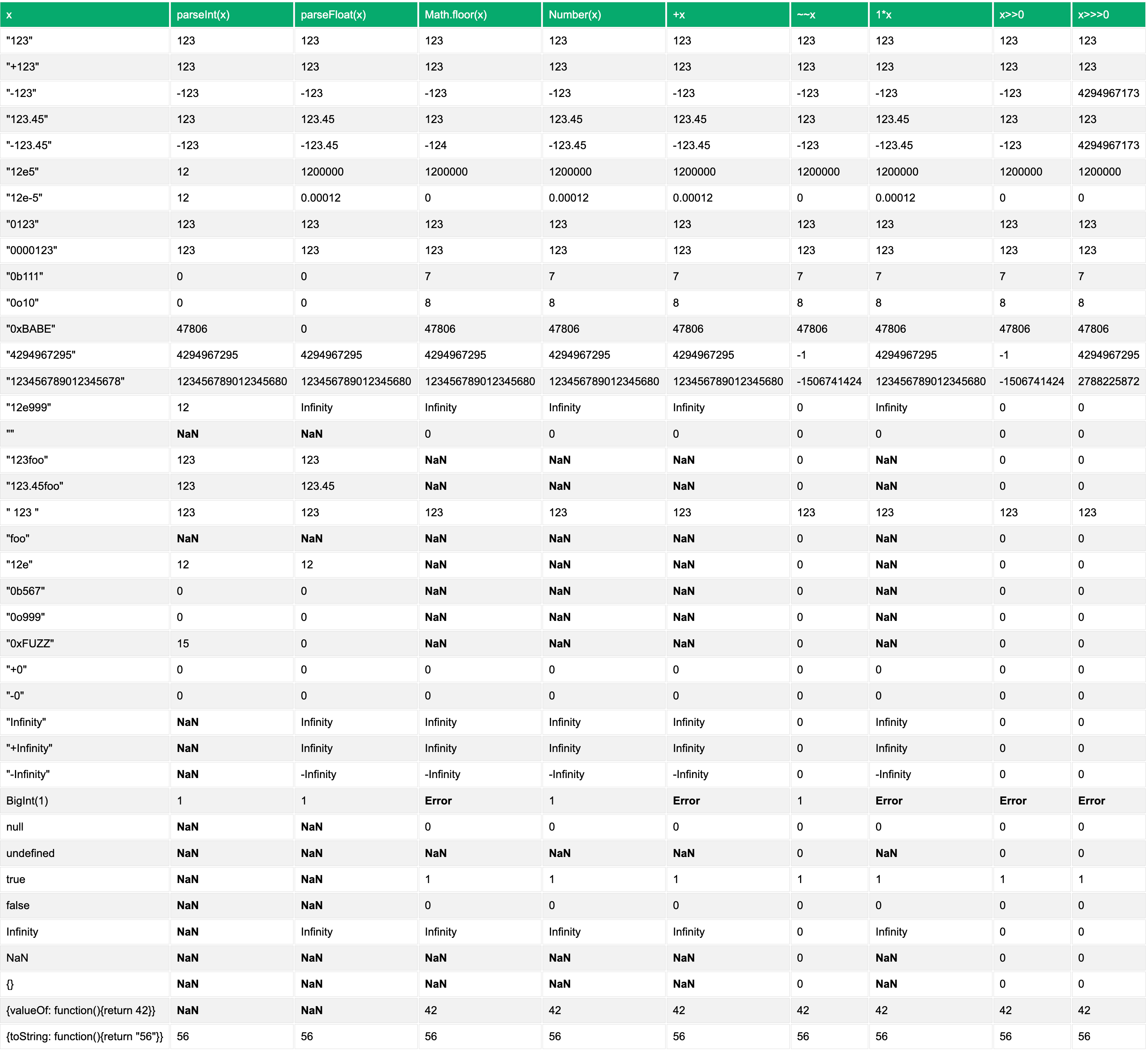 > 对比表格的源码发布到了 https://airing.ursb.me/web/int.html,需要可自取。